
A Nashville insurance brokerage had four people rekeying claim data between two systems. Eleven thousand entries a month. They bought robotic process automation licenses, built three bots in six weeks and cut the queue by 70 percent. Then a vendor updated one screen layout and every bot broke overnight. Nobody had planned for that.
That story repeats across the country. The technology works. The programs around it often don't. Companies buy licenses before they map processes, count savings before they count maintenance hours and discover the hard costs sitting underneath the demo about nine months in. It is a management problem more than a software one.
Still, the returns are real when the groundwork is done. Finance teams close books faster. Claims move in hours, not days. Banks pass audits with cleaner trails than they had before. The gap between those outcomes and the failures is preparation. In this blog, we will walk through how RPA works, what it costs and where it breaks.
Quick Answer: Robotic process automation is software that mimics how a person uses applications, clicking, typing, copying and validating data across systems by following rules. It suits high volume, repetitive, structured work like invoice entry, claims intake and reconciliations and it does not require changes to underlying systems.
Key Facts
- Gartner put worldwide RPA software revenue at $3.6 billion in 2024, growing 14.5 percent, with UiPath, Microsoft and Automation Anywhere leading.
- EY's widely cited estimate is that 30 to 50 percent of initial RPA projects fail to deliver what was promised.
- Bot maintenance typically runs 15 to 25 percent of original development cost every year.
- Entry pricing ranges from roughly $15 per user monthly for cloud flows to $50,000 or more annually for a small unattended bot fleet.
- A 10 bot enterprise deployment commonly lands between $45,000 and $85,000 per year at list price, less after discounting.
- Deloitte's automation research found integration difficulty, skills gaps and resistance to process change are the top barriers to scaling.
What Is Robotic Process Automation?
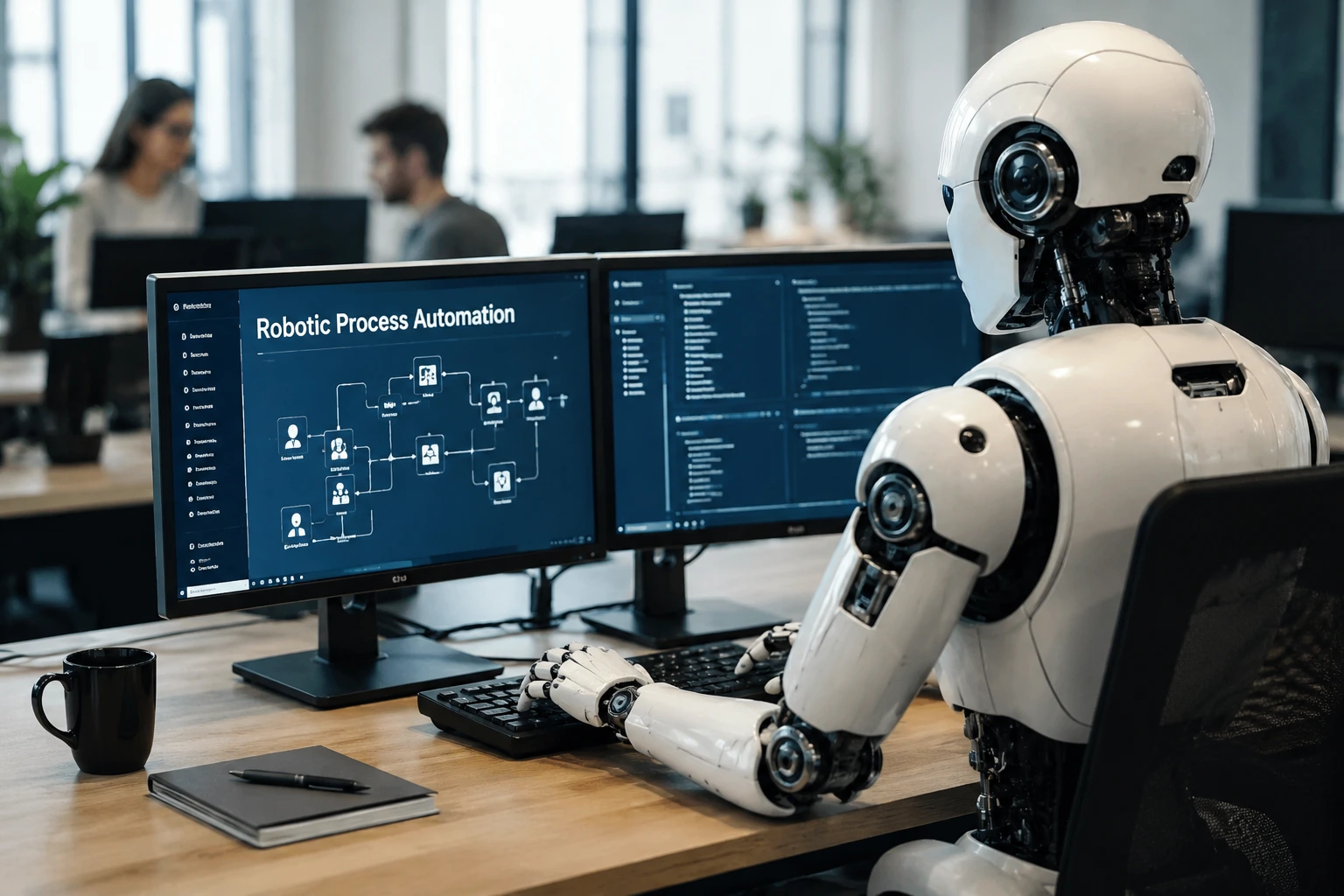
Robotic process automation is software that does what a person does on a screen. It opens applications, reads fields, copies values, pastes them somewhere else, checks them against a rule and moves on. No arms, no machines, nothing physical. The word "robotic" throws people off constantly.
These software robots work at the interface layer. That is the part that matters. Instead of connecting through an API or a database, they sit on top of whatever is already there, which is why RPA got traction in banks and insurers running systems built in the nineties that nobody wants to touch.
A useful test: if you can write down every step of a task, including what to do with exceptions and a temp could follow it without asking questions, a bot can probably run it. If the steps end with "and then you use your judgment," you are outside RPA territory and into something else.
The category is roughly twenty years old in its modern form, coming out of screen scraping and old workflow tooling. What changed recently is that the interface layer got smarter. Bots now read documents, handle some variation and hand off to AI models when they hit something they cannot classify.
How RPA Actually Works
The Pieces Inside an RPA Setup
Every platform sells the same three parts under different names. A design studio, where a developer records or drags out the steps. A runtime, which is the bot itself executing on a virtual machine or a user's desktop. And an orchestrator, the control room that schedules jobs, hands out credentials, queues work and logs everything.
The orchestrator is the piece buyers underestimate. Running four automation bots without one is fine. Running ninety without one is chaos, because you have no idea which bot touched which record when the auditor asks.
Underneath sits a credential vault, a queue system for work items and usually some form of exception handling that routes failures to a human. Most real deployments also add document processing, since a surprising amount of "structured" business data arrives as a scanned PDF.
What Makes a Process a Good Fit
High volume. Rule based. Stable inputs. Digital data. Low exception rate. Those five conditions do most of the qualifying work.
What people get wrong is volume. A process that runs eight times a month is rarely worth building even if it is annoying. The build cost stays the same whether the bot runs eight times or eight thousand.
Exception rate matters even more. A process with 5 percent exceptions is fine. At 30 percent exceptions you have built an expensive machine that generates work for a person to clean up and the team quietly stops trusting it. What we often see in practice is that nobody measured the exception rate before the build. They estimated it. The estimate was optimistic.
Attended, Unattended and Hybrid: The Three Types of RPA
Attended automation runs on a person's machine, triggered by them. Think of a call center agent hitting a key while the customer is still on the line and having account data pulled from four systems into one view. It shortens handle time. It does not run overnight.
Unattended automation runs on a server, on a schedule or a trigger, with no human present. Overnight reconciliations, batch invoice posting, month end reporting. This is where the labor savings actually live and it is also the licensing tier that costs real money.
Hybrid is both, chained together. A person kicks off a request, the unattended fleet does the heavy processing and the result comes back to the person for approval. Most mature programs end up here, though almost nobody starts here.
One practical note. Attended bots create a support burden that unattended bots do not, because they run on hundreds of individual desktops with different patch levels, screen resolutions and open applications. Support tickets scale with seat count.
Why Robotic Process Automation Matters to a Business
Cost and Capacity
The pitch is usually framed as headcount. In practice, the clearer win is capacity. A shared services team processing 40,000 invoices a month can take on the acquired company's 15,000 without hiring and that is easier to defend in a budget meeting than a layoff plan.
Cost per transaction is the metric worth tracking. If manual invoice entry costs $2.80 fully loaded and the bot brings it to $0.40, the math is legible. Vague productivity claims are not.
Accuracy and Audit Trails
Bots do not get tired at 4pm on a Friday. They also do not improvise, which cuts both ways.
The audit angle is underrated. Every action a bot takes is timestamped and logged, which means a SOX walkthrough that used to involve pulling emails and asking three people what happened becomes a query. Internal audit teams tend to become the strongest advocates in a company once they see this. Competitors use this aggressively in regulated sectors.
Speed, Uptime and Surge Handling
Cycle time is where employees notice the difference. A claims intake that took two days because of queue depth finishes in forty minutes because the bot runs at 2am.
Surge handling is the quieter benefit. Open enrollment, tax season, Black Friday returns. You spin up more bot instances for six weeks instead of hiring and training temps who leave in January.
Where Companies Actually Use RPA
Banking and Financial Services
BFSI is the largest adopter and has been since the beginning. Know your customer checks, sanctions screening, account opening, mortgage document collection, trade reconciliation, dispute processing. The work is high volume, heavily regulated and spread across systems that do not talk to each other.
A regional bank in Phoenix running KYC refresh across 60,000 accounts is a textbook case. The bot pulls documents, checks expiry dates, flags gaps and only escalates the ones that need a person.
Healthcare and Insurance
Eligibility verification, prior authorization, claims intake, denial management and revenue cycle work. Providers run some of the most fragmented system landscapes in the country and payer portals rarely offer usable APIs.
The compliance layer is heavier here. Any bot touching protected health information needs HIPAA aligned access controls and the credential model has to survive an audit.
Manufacturing and Supply Chain
Purchase order creation, supplier onboarding, inventory syncing between ERP and warehouse systems, shipment tracking updates and quality documentation. Manufacturers often run several ERPs after acquisitions and RPA becomes the glue nobody budgeted for but everybody uses.
Finance, HR and Customer Support
By function rather than industry, the usual suspects are accounts payable, accounts receivable, order to cash, month end close, payroll validation, employee onboarding and offboarding, benefits administration and ticket triage.
Employee offboarding is a good starter project. It is rule based, it spans six or seven systems, it is done badly almost everywhere and it has a security consequence when someone's access lingers for three months after they leave.
RPA Tools and Software: The Vendor Landscape
The Main Platforms
Gartner's market share work put UiPath, Microsoft and Automation Anywhere at the front of the RPA software market in 2024, with SS&C Blue Prism still significant in large regulated enterprises. Microsoft competes largely on bundling, since Power Automate Desktop ships with Windows and lands cheaply for organizations already deep in Microsoft licensing.
Open source options exist for teams comfortable running their own infrastructure. They are viable for mid-market use and painful for anyone who needs vendor support at 3am.
Capabilities Worth Paying For
When comparing RPA tools, the demo will look identical across vendors. The differences show up in year two:
- Orchestration and queue management at scale
- Credential vaulting and role based access
- Document understanding for semi-structured inputs
- Process and task mining to find candidates
- Version control, testing and promotion between environments
- Logging depth and exportable audit trails
- Resilience features like automatic retry, selector repair and failure routing
That last group is what separates RPA software that survives an application upgrade from RPA software that generates a support ticket every Tuesday.
What RPA Costs and When the Return Shows Up
Published pricing is deliberately opaque, but the shape is knowable. Cloud flow licensing starts around $15 per user monthly. Desktop RPA seats sit closer to $40. Small unattended fleets from the enterprise vendors start near $50,000 annually for around five bots and a ten bot deployment commonly lands between $45,000 and $85,000 per year at list, with meaningful discounting available.
License cost is rarely the problem. Three other numbers are.
Development. Building a bot ranges from a few thousand dollars for something simple to well into six figures for a complex, multi-system process with heavy exception handling.
Infrastructure. Unattended bots need machines and those machines need patching, monitoring and access management.
Maintenance. Budget 15 to 25 percent of the original build cost every year, permanently. This is the line item that gets left out of the business case and it is the reason year two ROI often looks nothing like the slide from year one.
Before you write a robotic process automation business case, model three years, not one and include the maintenance tail. Payback on a well chosen first process is usually somewhere between six and eighteen months. Anyone promising six weeks is selling.
Where RPA Programs Fall Apart
EY's often quoted finding is that 30 to 50 percent of initial RPA projects fail to deliver. That number has held up for years, which tells you the failures are structural rather than technical.
Automating a Broken Process
The most expensive mistake in the category. If a process has fourteen steps because of a workaround somebody invented in 2019, automating it locks that workaround into code and makes it harder to remove.
Fix first, then automate. Sometimes the fix eliminates the need for the bot entirely, which nobody wants to hear after a platform has been purchased.
Maintenance Debt and Brittle Bots
Bots break when applications change. Not if. A vendor pushes a UI update, a field moves twelve pixels and the selector fails. Multiply that across sixty bots touching twenty applications and you have a full time job that nobody was hired for.
Teams that survive this build with resilient selectors, wrap everything in error handling and monitor bot health as a production system rather than a side project.
Governance, Credentials and Security
Bots need logins. Those logins often have broad permissions, sit in a shared vault and outlive the person who requested them. Security teams that were not consulted during the pilot tend to find out later and the conversation is not pleasant.
Treat every bot as a named identity with least privilege access, an owner and a review date. Most people realize this too late.
Getting Stuck After the Pilot
Deloitte's automation research points at the same three barriers repeatedly: difficulty integrating solutions, missing skills and experience and an inability to change how work is actually done. Pilots succeed because a motivated team hand-carries them. Scaling needs reusable components, shared infrastructure and someone accountable for the portfolio.
How to Implement RPA Step by Step
- Find candidates properly. Use process mining or a structured discovery workshop rather than asking managers what annoys them. Rank by volume, stability, exception rate and how many systems are involved.
- Build the business case per process. Cost per transaction now, cost per transaction after, build estimate, three year maintenance. If the payback exceeds eighteen months, park it.
- Fix the process before you code it. Remove the workarounds. Standardize the inputs. Write the exception rules down.
- Pilot with one process and real volume. Not a toy. Real data, real edge cases, real users.
- Stand up governance early. Naming standards, credential model, environments, testing, deployment approval and a support rota.
- Set up a center of excellence when you cross roughly ten bots. Reusable components, a shared library and a single owner for the portfolio.
- Measure and prune. Track uptime, exceptions handled, transactions processed and cost per transaction. Retire bots that stopped earning their license.
What RPA Means for Jobs
The honest version is more mixed than either side claims.
Roles built entirely on data entry do shrink. That is real and it happens through attrition more often than layoffs, because most companies discover the retraining cost is lower than the rehiring cost.
The bigger shift is task level. A finance analyst who spent 60 percent of the week extracting and formatting data spends it on variance analysis instead. That is genuinely better work and it also raises the skill floor for the role, which is harder on some people than the automation narrative admits.
New roles appear too. Bot developers, automation analysts, process owners and a support function that did not exist three years ago. Just fewer of them than the roles that shrank.
RPA vs AI, BPM and API Integration
RPA follows rules. AI makes probabilistic judgments. A bot cannot decide whether an invoice looks fraudulent, but it can route it to a model that scores it and then act on the score.
BPM is the wider discipline of designing and orchestrating end to end processes. RPA is a tactic inside it. Buying RPA without process design is how companies end up with sixty bots and no map.
API integration is almost always the better option when it exists. It is faster, more stable and it does not break when a screen changes. RPA earns its place precisely where APIs are missing, expensive, or blocked by a vendor. Treat it as the option you use because the clean path is closed, not as the default.
Intelligent Automation, Hyperautomation and the Move to AI Agents
Intelligent automation is RPA plus document understanding, machine learning and natural language processing. It widens the scope from structured data to messy inputs like emails, contracts and scanned forms.
Hyperautomation is the strategy layer on top of that. Discover everything automatable, automate it with whatever tool fits and orchestrate the lot.
The current wave is agentic. Gartner forecasts that up to 40 percent of enterprise applications will include task specific AI agents by the end of 2026, up from under 5 percent in 2025. Agents plan, adapt and call tools rather than following a fixed script. That is a real architectural difference.
It is also where the marketing gets loose. Gartner has warned about agent washing, meaning vendors relabeling existing automation as agentic. When evaluating, ask whether the system reasons toward a goal and adapts when a step fails, or whether it is a script with a chat interface.
The Future of Robotic Process Automation
RPA is not disappearing. It is becoming the execution layer underneath something smarter.
The pattern taking shape is straightforward. An agent handles the reasoning, deciding what needs to happen and in what order. Deterministic bots handle the execution, because in a regulated process you want the step that posts to the general ledger to behave identically every single time. Nobody wants a probabilistic model improvising inside a payment run.
Gartner's own numbers show the RPA software market still growing, though the growth rate slowed in 2024 as generative AI absorbed attention and budget. Analyst market sizing varies wildly depending on whether services are counted, from roughly $3.6 billion for software alone to figures near $28 billion when implementation services are included. Read the methodology before you quote the number.
The practical takeaway for a buyer in 2026: choose a platform that governs both bots and agents from one control plane and do not rip out working automation to chase an architecture that is still settling.
Key Takeaways
- RPA works at the interface layer, which is why it fits legacy systems that have no usable API.
- Volume, rule clarity and low exception rates decide whether a process is worth automating. Annoyance does not.
- License cost is the small number. Development, infrastructure and 15 to 25 percent annual maintenance are the real ones.
- Governance, credential management and a center of excellence are what separate a pilot from a program.
- Fix broken processes before automating them, or you encode the dysfunction permanently.
- Agentic AI is changing the reasoning layer, not eliminating the need for deterministic execution.
Conclusion
Robotic process automation earns its keep when it is treated as an operations discipline rather than a software purchase. The companies getting real value from it did unglamorous things first. They mapped processes honestly, measured exception rates before building, fixed the workarounds and budgeted for maintenance that never ends. The ones that struggled bought RPA software, built automation bots quickly and hit year two with a maintenance bill nobody owned.
Start narrow. Pick one high volume process with clean rules, prove cost per transaction, then build the governance that lets you go from three bots to thirty without losing track of credentials or audit trails. Compare RPA tools on orchestration, resilience and logging rather than the demo, because everything demos well.
Software robots are still the most reliable way to execute repetitive digital work and that stays true as AI agents take over the thinking above them. The strategy has not changed much. The tooling around it has.
Sources
- Gartner, Market Share Analysis: Robotic Process Automation, Worldwide, 2024 (2025). Link: https://www.gartner.com/en/documents/6842834
- Gartner press release, Gartner Predicts 40% of Enterprise Apps Will Feature Task-Specific AI Agents by 2026 (August 2025). Link: https://www.gartner.com/en/newsroom/press-releases/2025-08-26-gartner-predicts-40-percent-of-enterprise-apps-will-feature-task-specific-ai-agents-by-2026-up-from-less-than-5-percent-in-2025
- EY, Get Ready for Robots, cited in peer-reviewed RPA governance research, ScienceDirect (2026). Link: https://www.sciencedirect.com/science/article/pii/S146708952600014X
- Deloitte automation survey findings on barriers to scale, as reported by V-Soft Consulting (2025). Link: https://blog.vsoftconsulting.com/blog/why-40-of-rpa-implementations-fail-6-ways-to-succeed
- Automation Atlas, RPA Pricing Comparison 2026: UiPath, Automation Anywhere, Blue Prism, Power Automate (2026). Link: https://automationatlas.io/answers/rpa-pricing-comparison-2026/
— Bookmark our website for future reference, and explore our site to access more detailed expert content.
Frequently Asked Questions
How long does it take to build a single RPA bot?
Bot build time spans design to production. Simple single-system tasks take one to three weeks. Complex multi-system processes with heavy exception handling take two to four months. A payroll validation bot commonly needs around six weeks.
Can RPA work with legacy systems that have no API?
Yes. RPA operates at the user interface layer rather than through APIs, so it works with systems exposing no integration options. Example: a 1990s mainframe policy system accessed through a terminal emulator.
What happens to a bot when the underlying application is updated?
Bots fail when interface elements move or change. The automation looks for a screen element that no longer matches its selector and errors out. Example: a vendor portal redesign breaking every bot that logs in.
Is RPA worth it for a small business?
RPA suits small businesses with genuinely repetitive digital volume. Below a few thousand transactions monthly, low-code workflow tools usually cost less. Example: a 40-person distributor automating order entry from emailed purchase orders.
Which processes should never be automated with RPA?
Processes with frequent exceptions, unstable inputs, or genuine judgment should stay manual. Automating them creates rework rather than savings. Example: credit exception approvals, where each decision depends on context a rule set cannot capture.
How do software robots log in to applications securely?
Bots retrieve credentials from an encrypted vault inside the orchestrator at runtime rather than storing them in scripts. Each bot uses a named service account with least privilege access. Example: a read-only account for a reporting bot.
What is an RPA orchestrator?
An orchestrator is the central control plane that schedules bots, distributes work queues, issues credentials and records logs. It turns individual automations into a managed fleet. Example: assigning 200 queued invoices across five available bot runners.
When should a company choose unattended automation over attended?
Unattended automation suits scheduled, high-volume back-office work needing no human present. Attended suits real-time desktop assistance. Example: overnight bank reconciliations run unattended, while call-center account lookups run attended.
Does RPA require changes to existing IT systems?
No. RPA sits on top of existing applications and requires no code changes to them. That is its main advantage over integration projects. Example: automating an ERP screen without involving the ERP vendor.
What is a center of excellence in automation?
A center of excellence is a central team setting automation standards, reusable components, governance and support. It prevents duplicated builds across departments. Example: one shared login component reused by forty bots instead of rebuilt each time.
Can RPA handle scanned invoices and other unstructured documents?
Yes, with intelligent document processing added. Optical character recognition extracts text and machine learning models classify fields, then the bot validates and posts the data. Example: reading supplier invoices arriving as scanned PDFs.
Which metrics show whether an RPA program is working?
Useful metrics include transactions processed, cost per transaction, bot uptime, exception rate and hours returned. Vague productivity claims are not measurable. Example: invoice entry falling from $2.80 to $0.40 per transaction.
What is process mining and how does it relate to RPA?
Process mining analyses system event logs to reconstruct how processes actually run. It identifies automation candidates using evidence instead of opinion. Example: discovering that 30 percent of purchase orders follow an undocumented rework path.
Are RPA bots a security risk?
Bots hold credentials and permissions, so ungoverned deployments create risk. Shared accounts, excessive privileges and orphaned bots are the common failures. Example: a bot account retaining production access years after its process was retired.
What is hyperautomation?
Hyperautomation is a strategy of identifying and automating as much work as possible using combined tools, then orchestrating them together. RPA is one component. Example: pairing process mining, RPA and machine learning across order-to-cash.
What is a citizen developer?
A citizen developer is a business user who builds automations with low-code tools instead of writing code. Governance keeps their work maintainable. Example: an accounts payable analyst building a supplier statement reconciliation flow.
Can RPA bots make decisions?
Traditional bots follow predefined rules and cannot exercise judgment. Decision-making requires an AI model the bot calls and then acts on. Example: a bot passing an invoice to a fraud-scoring model, then routing by score.
What is intelligent document processing?
Intelligent document processing combines optical character recognition with machine learning to extract structured data from unstructured documents. It handles layout variation that template-based extraction cannot. Example: pulling totals from invoices across 300 different supplier formats.
Do unattended bots need a dedicated machine?
Unattended bots need their own execution environment, usually a virtual machine, because they control the interface exclusively while running. Attended bots share a user's desktop. Example: ten unattended bots running on ten virtual machines.
What is agentic process automation?
Agentic process automation uses AI agents that plan steps toward a goal and adapt when something fails, calling bots and tools to execute. Example: an agent resolving a billing dispute across three systems.
How do I know whether my company is ready to start with RPA?
Readiness shows up as documented processes, measurable transaction volume, an executive sponsor and IT involvement from day one. If nobody can describe a process end to end without disagreement, start with process discovery instead.
What should I ask a vendor during an RPA demo?
Ask how the platform handles a selector break, how credentials are vaulted, what the audit log exports look like, how bots are promoted between environments and what maintenance customers of your size actually report.
Why did our automation program stall after the pilot?
Pilots usually stall because bots were built without reusable components, shared infrastructure, or a named owner. Scaling needs a governance model and a support function, not more licenses.
Should we invest in RPA now or wait for AI agents to mature?
Waiting rarely pays. Deterministic execution stays necessary in regulated processes even as agents handle reasoning. Choose a platform that governs bots and agents from one control plane rather than delaying automation entirely.