

An Austin SaaS founder sent 400 LinkedIn connection requests in one week using a cheap bot. Monday morning, his account was restricted. Six years of relationships, gone behind a verification wall. That is the double edge of LinkedIn automation: it can fill a pipeline or torch the account it runs on.
Done right, the picture flips. A two-person Denver agency books 12 to 15 discovery calls a month off a few hundred carefully targeted touches. Same platform, same tools even. The difference is never the software. It is the targeting, the message, the limits and the discipline to stop selling in the first line.
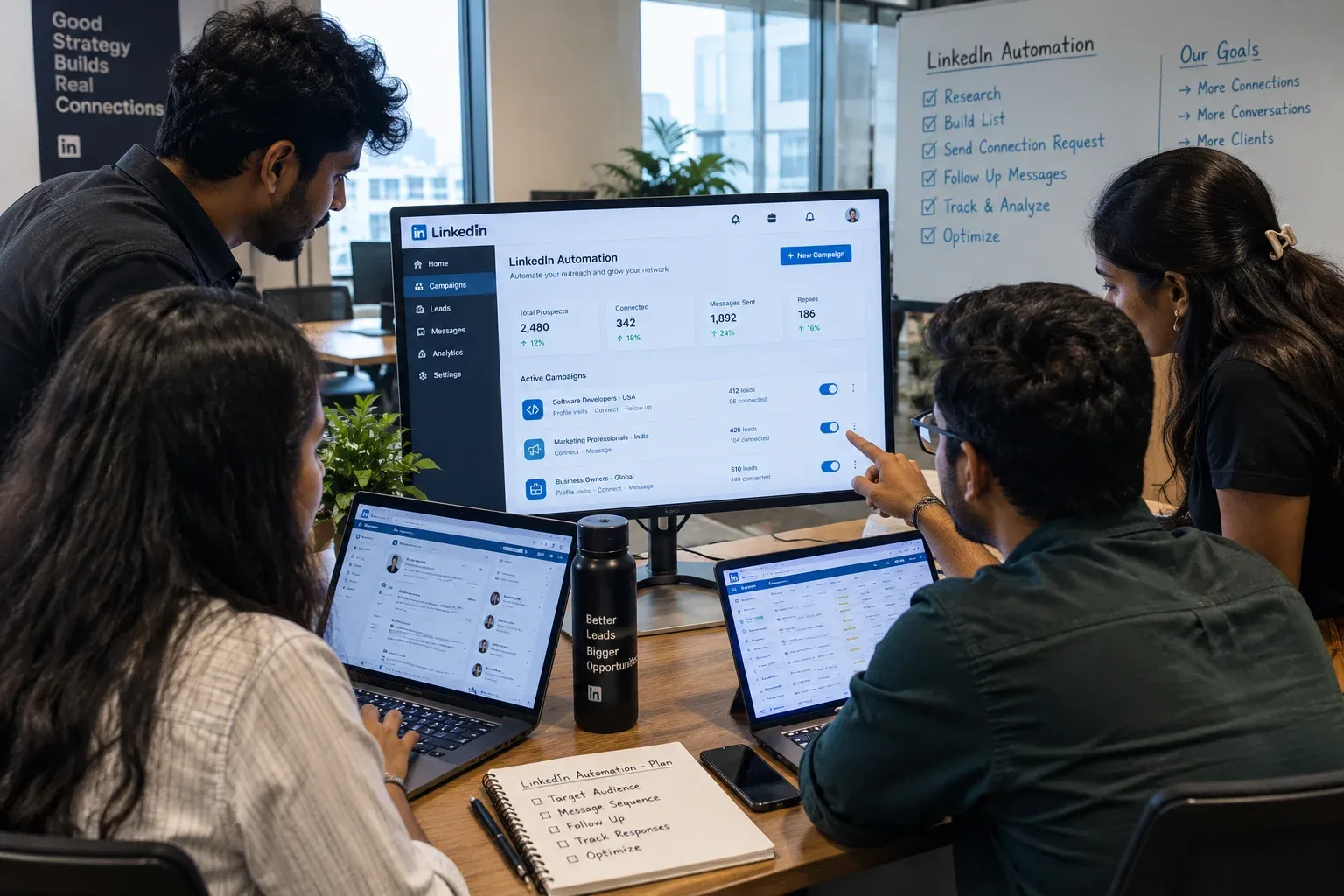
This guide covers both halves: the LinkedIn outreach strategy that earns replies and the tools that scale it without tripping alarms. In this blog, we will break down safe limits, compare the leading platforms with real pricing and walk through building message sequences that sound like a person wrote them.
Quick Answer
LinkedIn automation tools handle connection requests, follow-ups and multichannel sequences so reps prospect at scale. Expandi, HeyReach and Dripify lead for outreach, while PhantomBuster covers data extraction. Expect $39 to $100 per seat monthly, keep invites under roughly 100 per week and personalize every first touch.
Key Facts
-
LinkedIn caps most accounts near 100 connection requests per rolling seven-day window, with a practical daily ceiling of 20 to 25.
-
Third-party outreach automation sits outside LinkedIn's User Agreement, so every tool in this category carries some restriction risk.
-
Entry pricing spans about $11 monthly for Dux-Soup Pro to $99 per seat for Expandi, with agency bundles near $999.
-
Withdrawn invitations do not refund your weekly quota, so wasted sends are gone for good.
-
Cloud platforms with dedicated residential proxies leave a smaller detection footprint than Chrome extensions running in your own browser.
-
On warmed accounts with tight targeting, a 25 to 40% connection acceptance rate is a healthy range.
What Is LinkedIn Automation and Where Is the Line?
Most people picture spam bots. The reality is more mundane. These tools visit profiles, send connection requests, deliver follow-up messages on a schedule, withdraw stale invites and pull prospect data into spreadsheets and CRMs. The repetitive clicking an SDR would do for three hours, done quietly in the background.
Now the uncomfortable part, which most vendor pages bury. LinkedIn's User Agreement prohibits third-party software that automates activity or scrapes the platform. Enforcement runs from warnings to temporary restrictions to permanent bans and it comes in waves. Community reports describe at least one aggressive sweep already in 2026. Every tool in this article operates in that gray zone, whatever its homepage says about being the safest on the market.
There is a sanctioned side of the line worth knowing. Post schedulers built on LinkedIn's official partner APIs, tools like Buffer or Hootsuite, are fine. Sales Navigator is LinkedIn's own product. CRM integrations through official channels are fine. It is the outreach actions, the invites and messages sent by software, that sit outside the rules. Treat that as a business risk you are choosing to manage, not a technicality.
Cloud, Browser Extension, or Desktop: The Setup Decision That Matters
Where the automation physically runs shapes your risk more than any feature does.
Browser extensions like Dux-Soup or Waalaxy operate inside your own Chrome session, on your IP and only while the browser stays open. They are cheap and quick to start. They are also the easiest pattern for LinkedIn to spot and campaigns stall every time your laptop sleeps.
Cloud platforms like Expandi, HeyReach, Dripify and Skylead run on their own servers around the clock, typically assigning each account a dedicated residential proxy so logins always come from one consistent location. Randomized delays mimic human pacing. You pay more for that architecture and it is usually worth it.
Desktop tools like Linked Helper split the difference: cheaper than cloud, safer-looking than an extension, but your machine has to stay on.
There is no zero-risk option. What we often see in practice: teams that treat the account as a real asset go cloud and teams testing the waters start with an extension, then migrate.
Building a LinkedIn Outreach Strategy That Gets Replies
Tools amplify whatever you feed them. Feed them a lazy list and a pushy pitch and they generate rejection at scale. The strategy below is what separates the shops booking meetings from the ones burning accounts.
Start With the ICP, Not the Tool
B2B LinkedIn lead generation lives or dies on the list. A Chicago payroll consultancy I watched rebuilt its whole motion around one filter change: instead of "HR professionals," they targeted HR directors at manufacturers with 50 to 200 employees in the Midwest. Reply rates tripled. The message barely changed.
Write the ICP down before touching software. Industry, headcount, seniority, geography and one trigger that makes now the right time, like a recent funding round or a job posting. Then be honest about list size. Three hundred right people beat three thousand almost-right people and at 100 invites a week, three hundred is a month of runway anyway.
Build Lists With Sales Navigator, Not Basic Search
Free LinkedIn search caps out fast and its filters are blunt. LinkedIn Sales Navigator, at about $100 monthly, is the targeting layer most serious outbound runs on: seniority filters, headcount ranges, posted-in-the-last-90-days activity, saved searches that surface new matches weekly.
Two habits pay off. First, filter for people who actually use LinkedIn, because a perfect-fit prospect who never logs in cannot accept your invite. Second, save the search and let it drip new prospects into your campaigns instead of rebuilding lists monthly. Most linkedin prospecting tools plug straight into Sales Navigator URLs, so a tight saved search becomes the faucet for everything downstream.
Write Automated LinkedIn Messages That Don't Read Automated
The connection request is not the pitch. Send it blank, or with one short line referencing something real. Recent practitioner tests keep finding that noteless invites accept at the same rate or better, mostly because a salesy note gets you declined before hello.
The first message after acceptance is where automated LinkedIn messages usually give themselves away. Keep it under 60 words. One observation about them, one genuine question, zero links, zero calendar asks. Personalize on real signals, their post from last week, the hire they announced, not on merge tags. "Hi {first_name}, I see you work at {company}" is not personalization. It is a form letter with confetti.
And skip the gimmicks. AI voice clones and video thumbnails are novel exactly once.
Sequences, Follow-Ups and Knowing When to Stop
A working sequence is short. Invite on day zero. Opener two or three days after acceptance. A value follow-up around day seven, something actually useful like a relevant teardown or benchmark, not a brochure. A polite closer near day fourteen that makes it easy to say no.
That is it. Reply rates fall off a cliff after the fourth touch and the eight-step guilt-trip sequences floating around sales forums mostly generate blocks. Every platform worth paying for stops the sequence automatically the moment someone replies. Confirm that feature exists and is on, because one automated message landing mid-conversation undoes weeks of goodwill.
For prospects who never accept: withdraw after three or four weeks, wait a quarter and re-approach with a warmer angle, like commenting on their posts first.
Layer Email on Top of LinkedIn
The best-performing outbound in 2026 rarely lives on one channel. LinkedIn opens the door, email carries the detail. Tools like Skylead, lemlist and Waalaxy find and verify a prospect's work email, then branch the sequence: connection accepted gets a LinkedIn message, ignored gets an email referencing the invite.
The channels reinforce each other. A name someone half-remembers from a connection request gets a warmer read in the inbox. Keep the story consistent across both, keep everything logged in one place and never send the same text to both channels. People notice and it reads exactly like what it is.
The Numbers That Tell You It's Working
Watch four numbers weekly. Acceptance rate: 25 to 40% is healthy with tight targeting on a warmed account. Reply rate on connected prospects: 10 to 25% is a reasonable band. Positive reply rate: usually 3 to 8%. Booked meetings: somewhere around 1 to 3% of the total list, more often than not.
Below 20% acceptance, stop and fix the list or the profile before touching volume. Your profile is the landing page for every invite you send and a headline that screams quota gets ignored. Split test one variable at a time, the first line before anything else and give each test a few hundred sends before believing it.
Safe Sending Limits and Account Warm-Up
The numbers that matter, based on vendor documentation and community testing as of mid-2026. LinkedIn does not publish exact figures and your personal ceiling flexes with account age, acceptance rate and SSI.
Most accounts hit a wall near 100 connection requests per rolling seven-day window. The window resets seven days after each send, not on Mondays. Warmed accounts with strong signals sometimes stretch toward 150 to 200, especially on Sales Navigator, while brand-new accounts often cap closer to 50 to 80. Free accounts also face tight limits on invites that include a note, which is one more argument for sending blank ones.
Daily, stay near 20 to 25 invites and spread them across business hours. Blasting the full weekly quota on Monday morning is exactly the pattern detection systems look for. Messages to existing connections tolerate more, maybe 25 to 50 daily on a mature account and profile views more still.
Ramp gradually. A new tool on an established account should start at a quarter of those numbers and build over two to three weeks. A new account should not run automation at all for its first month or two.
Two housekeeping rules. Withdraw pending invites older than a month, knowing withdrawal does not refund quota. And never point two tools at one account, since their combined activity counts as one very suspicious human.
The 8 Best LinkedIn Outreach Tools for 2026
The market splits into outreach platforms, which send things and prospecting tools, which find and extract data. Most teams end up with one of each. LinkedIn automation tools also change pricing constantly, so the figures below reflect vendor pages and published breakdowns as of mid-2026. Confirm before you subscribe.
1. Expandi: The Premium Cloud Standard
Expandi is the tool people name when they mean safe-as-this-gets. Fully cloud-based, a dedicated residential IP per account, granular caps per action type and smart sequences that branch on prospect behavior.
Pricing is $99 per seat monthly, dropping to $79 on annual billing, with a 7-day trial. Two catches. The flashy image and GIF personalization in the demos runs through paid add-ons that can push a loaded seat toward $200. And per-seat math punishes bigger teams: ten reps is $990 monthly before add-ons. Restriction complaints still show up in reviews, as they do for every tool here.
Best for: teams where LinkedIn is a primary pipeline channel and the account cannot be lost. Skip if: you are solo and price-sensitive, or you need deep native email.
2. HeyReach: Built for Agencies Running Many Accounts
HeyReach charges per connected LinkedIn sender, not per human user. Teammates, VAs and clients log in free, which quietly changes the economics for agencies. A unified inbox pulls every client conversation into one screen and sender rotation spreads volume across accounts.
The Growth plan runs about $79 per sender monthly, near $59 on annual billing. Agency bundles land around $999 monthly for a block of senders, with an unlimited tier above that. Budget extra for the residential proxies the agency tiers ask you to bring, roughly $5 to 15 per account, plus enrichment credits.
Best for: agencies and teams running five or more sender accounts. Skip if: you have one account and simple needs. You would be paying for scale you do not use.
3. Dripify: The Easiest On-Ramp
Dripify is the tool most first-timers can run on day one. Clean drip campaigns, a simple sequence builder, a built-in safety algorithm and an interface that does not require a webinar to understand.
Pricing starts at $39 per user monthly on annual billing, $59 monthly otherwise, with Pro and Advanced tiers at $59 and $79 annual. The Basic plan is genuinely basic: one campaign at a time, tight daily quotas and no split testing until you upgrade. Cloud-based, 7-day trial, per-user pricing throughout.
Best for: solo sellers and small teams that want a fast, low-drama start. Skip if: you need conditional sequence logic or heavy multichannel. Others do that part better.
4. Waalaxy: Freemium Start, Browser-Based Trade-Offs
Waalaxy is the easiest free way to feel what automation does. The free plan includes about 80 invitations monthly with basic sequences and paid tiers run roughly €19 to €69 monthly, with an aggressive annual discount. Prebuilt sequence templates get a first campaign live in minutes and email steps join at the higher tiers.
The trade-off is architecture. Waalaxy runs through a Chrome extension, so campaigns pause when the browser closes and the detection footprint is larger than cloud rivals. Longtime users also grumble about price increases over the past year.
Best for: solo founders validating whether outbound works before spending real money. Skip if: the account matters enough to justify cloud infrastructure. It usually does.
5. lemlist: Multichannel First, LinkedIn Included
lemlist made its name on personalized cold email and grew LinkedIn steps into the same sequence builder. If your motion is email-led with LinkedIn touches woven in, its conditional multichannel sequences and deliverability tooling are the draw.
The catch is which plan you need. LinkedIn steps live on the Multichannel plan at $109 per user monthly, about $87 on annual billing, with a 14-day trial. Per-seat pricing adds up for teams and credits for finding emails and phone numbers bill on top.
Best for: SDR teams running blended email and LinkedIn sequences from one screen. Skip if: you are LinkedIn-only. You would be paying for an email engine you will not use.
6. Skylead: Smart Sequences With Real Logic
Skylead's pitch is the smart sequence: if-then branches that adapt per prospect. Connection accepted, send a message. Ignored after a week, find the email and go there. Email bounced, fall back to an InMail. Each prospect gets the maximum number of sensible touches without manual triage.
Pricing is about $100 per seat monthly, flat, with email discovery and verification included rather than sold as credits. The builder takes an afternoon to learn and simple campaigns can feel over-engineered in it.
Best for: outbound teams that want every fallback path automated. Skip if: you want plug-and-play simplicity. The logic canvas is the product.
7. PhantomBuster: The Data and Prospecting Play
PhantomBuster is not really an outreach sequencer. It is a library of over a hundred automations, called Phantoms, that extract and enrich data: scrape a Sales Navigator search into a sheet, pull post commenters, collect event attendees, enrich profiles. Among linkedin prospecting tools, it is the Swiss Army knife feeding cleaner lists into whatever sends your messages.
Pricing starts around $69 monthly and bills on execution time and credits, which takes some watching. There is real flexibility here for technical users and real rope to hang yourself with if you scrape greedily.
Best for: growth folks building list pipelines and signal-based plays, like targeting a competitor's post commenters. Skip if: you want one tool that finds and messages people. Pair it with a sequencer instead.
8. Dux-Soup: The Budget Veteran
Dux-Soup has been auto-visiting profiles since before most rivals existed. The Chrome extension handles profile visits, connection requests and message drips at a price nothing cloud-based touches: Pro from about $11 monthly, Turbo near $55, with a cloud edition around $99 for those who outgrow the browser.
The extension model is the compromise. Your browser stays open, activity runs on your IP and the detection footprint is what it is. As a cheap way to learn the mechanics with modest volume, it still earns its keep.
Best for: budget-first solo users and consultants running light, careful volume. Skip if: you are scaling a team or protecting a high-value account. Graduate to cloud.
How Much Do LinkedIn Automation Tools Cost?
Short version: $11 to $109 per seat monthly across the mainstream tools and the subscription is rarely the whole bill.
|
Tool |
Published entry point, mid-2026 |
Pricing model |
|
Dux-Soup |
About $11 monthly, Pro plan |
Chrome extension tiers, cloud edition near $99 |
|
Waalaxy |
Free plan, paid from about €19 monthly |
Freemium tiers, browser-based, big annual discount |
|
Dripify |
$39 per user monthly on annual billing |
Cloud, per-user tiers to $79 annual |
|
HeyReach |
About $79 per sender monthly |
Per connected sender, agency bundles near $999 |
|
Expandi |
$99 per seat monthly, $79 annual |
Cloud, per seat, personalization add-ons extra |
|
Skylead |
About $100 per seat monthly |
Cloud, flat per seat, email discovery included |
|
lemlist |
$109 per user monthly for Multichannel |
Per user, email-led tiers below that |
|
PhantomBuster |
From about $69 monthly |
Execution time and credits |
Then the rest of the stack shows up. LinkedIn Sales Navigator at about $100 monthly for serious targeting. Enrichment credits for finding emails, often $50 or more monthly at volume. Proxies on agency setups. The realistic all-in for one active seat lands between $150 and $250 monthly and that is before anyone's salary.
One quiet pattern: several vendors in this category have raised prices on existing customers over the past two years. Screenshot your terms at signup.
How to Choose the Right Tool for Your Team
Solo Founder, SDR Team, or Agency
Team shape decides more than feature lists do. A solo founder testing outbound wants cheap and simple: Waalaxy's free plan or Dripify's entry tier, upgraded only after replies prove the motion. An SDR team of three to ten wants cloud safety, CRM sync and reporting a manager can read: Expandi, Skylead, or lemlist if email leads. An agency running client accounts needs multi-account architecture, a unified inbox and white-label reporting, which is HeyReach territory, with Expandi's agency plan close behind.
Buy for the team you will have in six months, not the org chart you hope for in three years. Migrating sequences and conversation history between platforms is miserable enough that most teams never do it.
The Safety Checklist Before You Pay
Before any card number changes hands, confirm the tool offers a dedicated residential proxy per account, randomized human-paced delays, hard caps you can set per action type, automatic stop-on-reply, gradual warm-up scheduling and activity confined to working hours. Then confirm what it refuses to do. A vendor promising unlimited invites or guaranteed no bans is telling you they will burn your account cheerfully.
Ask where your data lives and what exports look like, because the day you leave matters more than the day you join.
Questions to Ask on the Demo
Salespeople answer what you ask. Ask these:
-
What happens to running campaigns and conversation history if my account gets restricted mid-month?
-
Which limits are enforced by default and can my team raise them past safe levels without an admin noticing?
-
Is the proxy included in this price and is it residential and dedicated to my account?
-
How does stop-on-reply handle a prospect replying on a different channel?
-
What exactly exports if I cancel: contacts, messages, campaign stats, all of it?
Get the answers in writing. Demo promises have a short memory.
Common Mistakes That Get Accounts Restricted
The same failures repeat and they are almost never the tool's fault.
Pitching in the connection request. The fastest way to get ignored, reported and rate-limited, in that order. The invite earns the conversation. It is not the conversation.
Running full volume on day one. A quiet account that suddenly sends 25 invites daily looks exactly like what it is. Ramp over weeks, not mornings.
Fake personalization at scale. One broken merge tag, "Hi , loved what is doing," lands in front of two hundred people before anyone notices. Proofread the fallbacks and test-send to yourself first.
Ignoring the profile. Hundreds of invites pointing at a bare profile with no photo, no featured post and a headline full of buzzwords is paid traffic to an empty store.
Letting automation answer humans. The whole point is to buy time for real conversations. The teams that let sequences keep firing at engaged prospects convert curiosity into blocks.
And the big one: treating the channel as permanent. It rents you reach on someone else's platform, under rules you are breaking. Build the email list and the CRM record like the lease could end next quarter.
Key Takeaways
-
The list and the message decide results. The tool just scales whatever you feed it, good or bad.
-
Stay near 100 invites per rolling week and 20 to 25 per day, spread across business hours, with a slow ramp on any new setup.
-
Cloud platforms with dedicated proxies, like Expandi, HeyReach, Dripify and Skylead, are the safer architecture. Extensions are the cheaper one.
-
Budget $150 to $250 all-in per active seat once Sales Navigator and enrichment credits join the stack.
-
Hand every reply to a human immediately. Automation should never negotiate, quote, or close.
Final Take: Automate the Grunt Work, Keep the Conversations Human
LinkedIn automation earns its keep when it removes repetitive work and stays out of the actual conversation. Let software send the invites, space the follow-ups and log the replies. The moment a prospect answers, a human should take over, because deals close on judgment, not sequences.
Build the LinkedIn outreach strategy first: a tight ICP, a list pulled from Sales Navigator, messages that lead with the prospect's problem. Then pick from the LinkedIn outreach tools that match your setup, cloud-based if the account matters to you and keep daily activity inside the limits that warmed accounts tolerate.
And accept the trade honestly. Automation sits outside LinkedIn's rules, so run it like it could end tomorrow: export your data, warm up slowly and never bet the whole pipeline on one channel. The teams that treat it that way keep compounding while everyone else restarts from zero. That part never changes.
Sources
-
LinkedIn User Agreement (2026)
Frequently Asked Questions
Can I pause a live campaign without losing sequence progress?
Most established platforms allow campaigns to be paused and resumed without resetting sequence progress. Prospects who have already been contacted retain their stage, while scheduled timers are paused until the campaign resumes. Pausing during holidays can be preferable to deleting a campaign.
Should I withdraw old pending connection requests?
It can be useful to clear connection requests that have remained unanswered for several weeks. However, withdrawing invitations does not restore previously used invitation capacity, so it is better to keep initial outreach targeted and relevant. Avoid relying on bulk cleanup tools without checking LinkedIn's current limits and policies.
Do connection requests work better with or without a note?
Test both approaches with your target audience. A short note can work when it references something genuinely relevant, while a generic sales pitch can reduce interest. Keep connection notes specific, concise, and focused on starting a relationship rather than immediately selling.
How do I warm up a brand-new LinkedIn account before outreach?
Build a complete profile, add relevant connections naturally, publish useful content, and engage with other users before starting significant outreach. New accounts should avoid sudden bursts of automated activity. Gradually increasing normal activity is safer than immediately running high-volume campaigns.
Does changing my LinkedIn password disconnect automation tools?
Often, yes. Changing your LinkedIn password can invalidate active sessions or credentials used by connected tools. You may need to reconnect the account and complete an additional verification step. If you use automation, plan password changes outside important campaigns.
Can automation tools message my existing first-degree connections?
Some platforms support campaigns targeting existing first-degree connections. This can be useful for reactivating dormant relationships or sharing relevant updates. Keep messaging targeted and moderate because existing relationships can be damaged by repetitive or overly promotional outreach.
What time of day should automated outreach go out?
Schedule outreach around the business hours of your target audience and account for their time zones. Weekday daytime activity is generally more appropriate for B2B communication than late-night or weekend messaging. Avoid using timing alone as a substitute for relevant targeting and messaging.
Can I run two automation tools on the same LinkedIn account?
It is generally better to use one automation platform per LinkedIn account. Running multiple tools can create overlapping activity, conflicting sessions, and excessive outreach. If you switch platforms, finish the migration and disable the previous tool before starting the new one.
Will prospects be able to tell I'm using automation?
Prospects can often recognize poor automation through generic messages, incorrect personalization, repetitive content, or instant responses that do not fit the conversation. Use relevant messaging and review replies manually. Once a prospect engages meaningfully, human follow-up is usually more appropriate.
How many follow-ups should a LinkedIn sequence include?
Two or three follow-ups after the initial message is a reasonable starting point. Space them over several days or weeks and stop when someone asks not to be contacted. The sequence should become less frequent rather than increasingly persistent when there is no response.
Can I sync LinkedIn replies and conversations to my CRM?
Many outreach platforms can synchronize contacts, campaign status, and outcomes with CRMs such as HubSpot, Salesforce, or Pipedrive through integrations or webhooks. The depth of conversation-history synchronization varies, so check exactly which fields and messages are transferred before choosing a platform.
What is a healthy acceptance rate for cold connection requests?
There is no universal healthy acceptance rate because results vary by industry, audience, profile quality, targeting, and outreach method. A low rate can indicate that the target list, profile positioning, or messaging needs improvement. Review those factors before increasing outreach volume.
Should I run outreach from my personal profile or a separate one?
For legitimate B2B outreach, use an authentic profile that accurately represents the person conducting the outreach. Established profiles with real professional history and relevant connections can provide more context than newly created accounts. Avoid fake or misleading profiles because they can create trust and account-compliance problems.
Can automation run while I use LinkedIn manually at the same time?
Technically, some cloud-based tools can operate while you browse LinkedIn manually. However, manual and automated activity can overlap and contribute to overall account activity. Keep track of both and avoid sending large volumes of invitations or messages manually while an automated campaign is active.
How do I message someone who never accepted my connection request?
Depending on the person's settings, options can include LinkedIn InMail, messaging an Open Profile member, or contacting them through a legitimate business email address. Another option is to stop pursuing the connection and re-approach later after establishing a warmer interaction through relevant content or engagement.
What is a smart sequence in LinkedIn outreach?
A smart sequence is an outreach workflow that uses conditions or prospect behavior to determine the next step. For example, a prospect who accepts a connection can receive a LinkedIn message, while a prospect who does not respond may move to another permitted communication channel.
What is an ICP in B2B prospecting?
ICP stands for Ideal Customer Profile. It describes the type of company and buyer most likely to benefit from and purchase a product or service. An ICP can include factors such as industry, company size, geography, technology stack, job roles, and business needs.
What is B2B prospecting?
B2B prospecting is the process of identifying and contacting potential business customers before they have expressed direct interest. It typically combines account research, list building, qualification, and outreach. For example, an SDR may identify target companies and contact relevant decision-makers.
What is a dedicated proxy in LinkedIn automation?
A dedicated proxy is a fixed internet connection or IP address assigned to a specific account or workspace within an automation service. It can provide more consistent connection characteristics, but it does not eliminate LinkedIn's account-security or usage policies. Proxy use should comply with the platform's terms.
What is spintax in outreach messaging?
Spintax is a message-template format that generates variations by rotating selected words or phrases. For example, a template can produce variations such as “Hi,” “Hello,” or “Hey.” It should be used carefully because artificial variations do not replace genuine personalization.
What is LinkedIn's Social Selling Index?
The Social Selling Index, or SSI, is a LinkedIn metric that measures aspects of professional brand building, finding the right people, engaging with insights, and building relationships. It is presented as a score from 0 to 100 and is primarily intended as a measure of social-selling activity on LinkedIn.
What is multichannel outreach in B2B sales?
Multichannel outreach coordinates multiple communication channels within one prospecting strategy, such as LinkedIn, email, and phone. The channels can complement one another while keeping messaging consistent. For example, an initial LinkedIn connection can be followed by a relevant business email.
What is a drip campaign on LinkedIn?
A drip campaign is a scheduled sequence of outreach messages delivered over a period of time rather than all at once. Each step is separated by a delay. For example, a prospect might receive an initial connection request followed by several relevant follow-ups over the following weeks.
What is LinkedIn Sales Navigator?
LinkedIn Sales Navigator is LinkedIn's sales prospecting product. It provides advanced search and filtering features, lead and account lists, recommendations, and messaging capabilities such as InMail, depending on the plan. Sales teams use it to identify and organize potential business prospects.
What is a unified inbox in outreach tools?
A unified inbox is a dashboard that brings conversations and replies from multiple accounts or communication channels into one interface. It allows sales teams to manage conversations without repeatedly switching between different accounts or applications.
Which LinkedIn automation tool is best for a solo founder on a budget?
The right tool depends on your required features, budget, account setup, integrations, and LinkedIn's current policies. Budget-conscious users can compare entry-level plans from tools such as Waalaxy, Dux-Soup, Dripify, and Expandi. Check current pricing, supported workflows, and compliance requirements before choosing a platform.
How long before LinkedIn outreach starts producing meetings?
Results vary significantly based on targeting, profile quality, offer, messaging, audience, and outreach volume. It can take several weeks to gather enough data to evaluate a campaign properly. Measure connection acceptance, reply rate, qualified conversations, and meetings rather than judging performance after only a few days.
Can I run LinkedIn automation for clients as an agency service?
Agencies can manage B2B outreach campaigns for clients using platforms that support multiple accounts or workspaces. Get clear written authorization from each client, define who controls the account, and document campaign activity and results. Also verify that the tools and workflows comply with LinkedIn's current terms and policies.
What should I do if my LinkedIn account gets restricted?
Stop automated activity and follow LinkedIn's instructions for verification or appeal. Review the activity that may have caused the restriction and avoid immediately restarting the same workflow. Once access is restored, prioritize compliant, lower-volume activity and make sure any third-party tools you use are permitted under LinkedIn's current policies.